


Parker Solar Probe
The Beginning
The Parker Solar Probe idea started in 1958 as a mission to study the particles and fields in the vicinity of the sun by the Fields and Particles Group or the Committee 8 of the National Academy of Sciences' Space Science Board. The idea was re-introduced throughout the following decades as more studies about the Sun arose, but the project was delayed due to financial costs. The project finally resurfaced in the early 2010s when it was incorporated into the plan of the Solar Probe Plus.
The initial idea was to use the gravity assist of Jupiter, but the redesigned mission uses Venus gravity assists instead. Using Venus’s gravity assist can be more advantageous as the probe itself can be powered by solar panels and that having a higher perihelion can reduce the need and usage of a thermal protection system. The name was coined at last in May 2017 when it was renamed in honor of astrophysicist Eugene Newman Parker who came up with the term “solar wind”. The project cost a total of US$1.5 billion. The probe launched on August 12, 2018, from Cape Canaveral Air Force Station aboard the DeltaIVrocket.Spacecraft Components/Scientific Instrument.
Parker Space Probe
The Innovation

The Parker Solar Probe idea started in 1958 as a mission to study the particles and fields in the vicinity of the sun by the Fields and Particles Group or the Committee 8 of the National Academy of Sciences' Space Science Board. The idea was re-introduced throughout the following decades as more studies about the Sun arose, but the project was delayed due to financial costs. The project finally resurfaced in the early 2010s when it was incorporated into the plan of the Solar Probe Plus. The initial idea was to use the gravity assist of Jupiter, but the redesigned mission uses Venus gravity assists instead. Using Venus’s gravity assist can be more advantageous as the probe itself can be powered by solar panels and that having a higher perihelion can reduce the need and usage of a thermal protection system. The name was coined at last in May 2017 when it was renamed in honor of astrophysicist Eugene Newman Parker who came up with the term “solar wind”. The project cost a total of US$1.5 billion. The probe launched on August 12, 2018, from Cape Canaveral Air Force Station aboard the DeltaIVrocket.Spacecraft Components/Scientific Instrument

Parker Space Probe
The Technology
Numbers of important scientific instruments were fitted into the Parker Solar Probe in order for us to get to learn more about the sun. The Integrated Science Investigation of the Sun or IS☉IS was used to measure energetic particles and ions. The Electromagnetic Fields Investigation (FIELDS) was an investigation that focused on the electric and magnetic fields of the Sun. The SWEAP or the Solar Wind Electrons Alphas and Protons was another investigation that will count the subatomic particles and measure their properties such as velocities and temperature. The Wide-field Image for Solar Probe or WISPR will be able to give us images of the sun’s corona and inner heliosphere. There are many more scientific instruments that help scientists achieve their goals of understanding more about the sun and benefiting how we live on Earth.
Solar Dynamic Observatory.
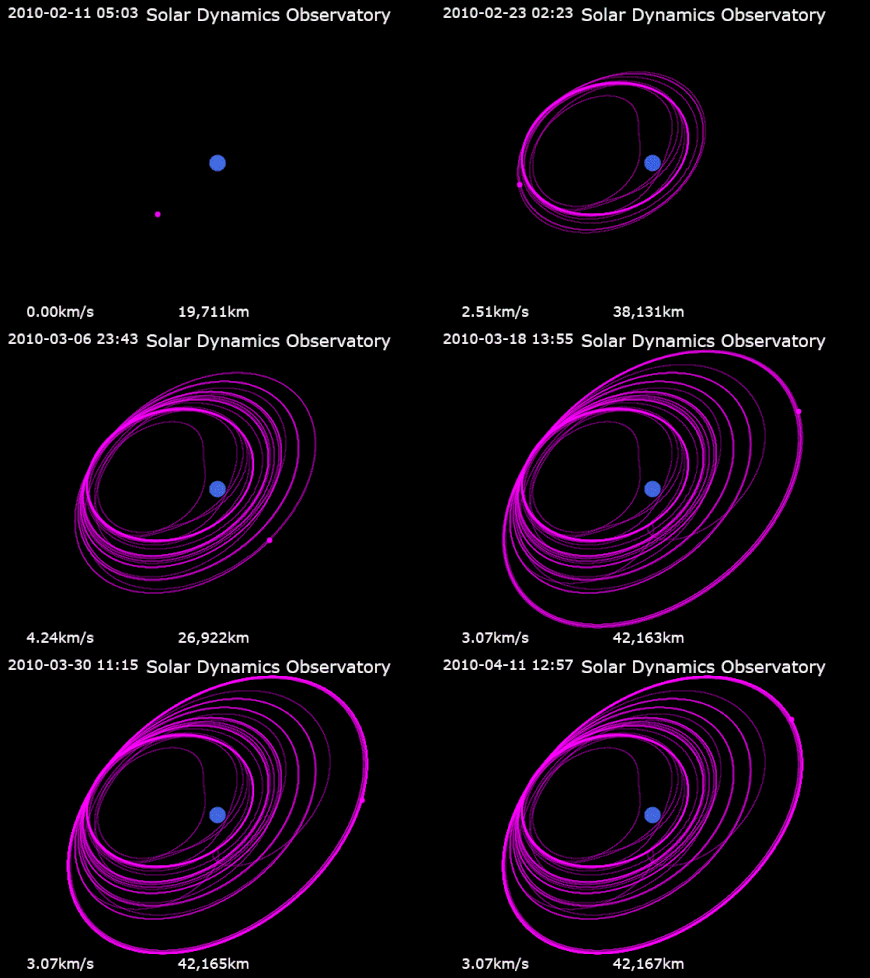
Launched on 11 February 2010, from Cape Canaveral Air Force Station (CCAFS), The SDO spacecraft was developed at NASA's Goddard Space Flight Center in Greenbelt, Maryland. The primary mission lasted five years and three months, with expendables expected to last at least ten years. Some consider SDO to be a follow-on mission to the Solar and Heliospheric Observatory (SOHO).
SDO is a three-axis stabilized spacecraft, with two solar arrays, and two high-gain antennas, in an inclined geosynchronous orbit around Earth.

EVE
The Extreme Ultraviolet Variability Experiment built in partnership with the University of Colorado Boulder's Laboratory for Atmospheric and Space Physics (LASP)

HMI
The Helioseismic and Magnetic Imager (HMI) built in partnership with Stanford University.

AIA
The Atmospheric Imaging Assembly built in partnership with the Lockheed Martin Solar and Astrophysics Laboratory.

Solar Orbiter
The Overview
Solar Orbiter is an international cooperative mission between ESA (the European Space Agency) and NASA that addresses a central question of heliophysics: How does the Sun create and control the constantly changing space environment throughout the solar system? The Sun creates a giant bubble of charged particles and magnetic fields blown outward by the Sun that stretches more than twice the distance to Pluto at its nearest edge, enveloping every planet in our solar system and shaping the space around us; heliosphere. To understand it, Solar Orbiter is traveling as close as 26 million miles from the Sun, inside the orbit of Mercury to measure the magnetic fields, waves, energetic particles and plasma escaping the Sun while they are still in their pristine state, before being modified and mixed in their long journey from the Sun.
Solar Orbiter
The Launch
Solar Orbiter launched from Cape Canaveral on a United Launch Alliance Atlas V 411 rocket on Feb. 9, 2020, at 11:03 p.m. EST. It now follows an elliptical orbit around the Sun, completing one revolution every 168 days. Using gravity assists from Venus and Earth, Solar Orbiter is gradually lifting itself out of the ecliptic plane, ultimately reaching an angle of 24 degrees above the Sun’s equator 33 degrees for the extended mission). From this vantage point, Solar Orbiter is capturing the first-ever images of the Sun’s north and south poles from high latitudes. At its fastest, Solar Orbiter can almost catch up to the Sun’s rate of rotation, allowing the spacecraft to hover over specific spots on the Sun as it turns and study how a single solar feature evolves over time.

Solar Orbiter
The Spacecarft
The Solar Orbiter is a three-axis stabilising platform that points itself towards the sun. A heat shield protects the spacecraft from high levels of solar flux near perihelion or the closest distance between the spacecraft and the sun. 21 sensors are fitted for remote-sensing experiments and the protection of the probe from the extremity of the Sun. The solar arrays used to power the mission are able to rotate about their longitudinal axis to avoid overheating. Telemetry and command subsystems are also included in order for the probe to be able to establish a communication link with Earth.
Science data is collected constantly as the probe explores the secret of the Sun. Communication with ground stations is important, so the Solar Orbiter operation reuses ESA’s infrastructure for Deep Space missions for the Solar Orbiter such as ESA’s space tracking station or the Mission Operation Centre (MOC) located at Darmstadt, Germany.
Ground stations around the world, mainly the station at Malargüe in Argentina, are also used for all operations and backups involving the spacecraft.
Solar Orbiter
The Spacecarft
Close approach with the Sun allows the Solar Orbiter to study and observe the magnetic activity in the atmosphere of the sun. These activities can be from solar flares, CME or Coronal Mass Ejections, and other phenomena that release energy. Joint coordination with NASA’s Parker Solar Probe will also be gathering significant data for scientists here on Earth. To gather these important datas, several scientific instruments are used. In the category of Heliospheric in-situ instruments, the EPD or the Energetic Particle Detector provided by Spain gives an insight on suprathermal and energetic particles. Other in-situ instruments such as the Solar Wind Plasma Analyser from the United Kingdom, the Magnetometer, and the Radio and Plasma Waves from France all proved to be essential in the operation. For an example of Solar remote-sensing instruments, the Polarimetric and Helioseismic Imager from Germany provides measurement of the photospheric vector magnetic field and line of sight velocity. A total of 10 instruments is included in the science payload.


Solar and Heliospheric Observatory
The Overview
The Solar and Heliospheric Observatory (SOHO) is a spacecraft built by ESA a in joint cooperation with NASA. It was launched on a Lockheed Martin Atlas II on December 2, 1995. It began normal operations in May 1996. Originally planned as a two-year mission, SOHO has operated for over 25 years in space. Not only does the probe do scientific research on the Sun’s outer layer, but it also proved to be essential in providing near-real-time solar data for space weather predictions. Some examples of the scientific instrument include the Coronal Diagnostic Spectrometer (CDS) which measures density, flow, and temperature of the corona, and the Large Angle and Spectrometric Coronagraph (LASCO) which studies the evolution and the structure of the corona. There are over 12 scientific instruments in total, and all of them contributes to specific aspects of the Sun’s
Solar and Heliospheric Observatory
The Orbit
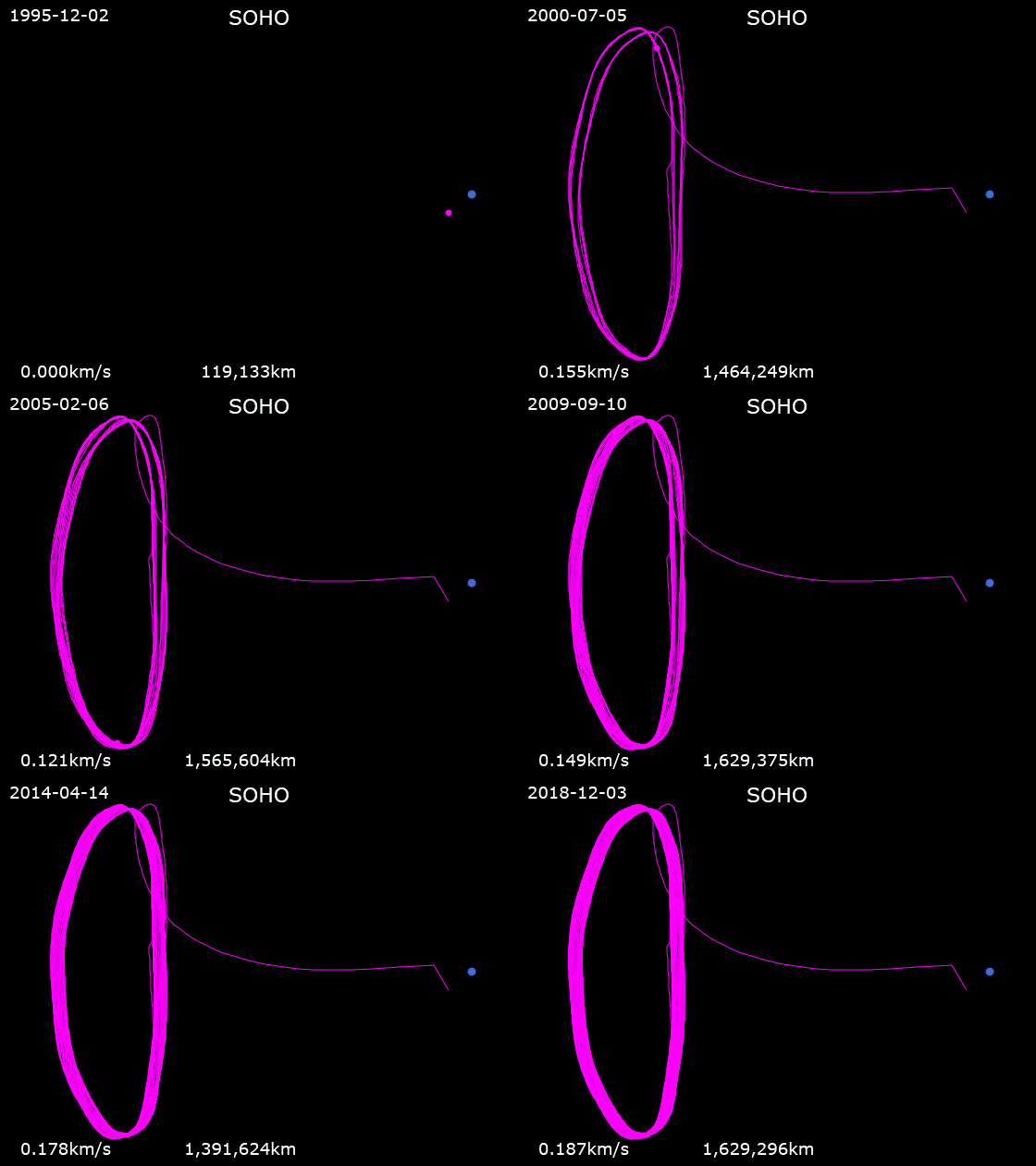
The SOHO spacecraft is in a halo orbit around the Sun-Earth L1 point, the point between the Earth and the Sun where the balance of the (larger) Sun's gravity and the (smaller) Earth's gravity is equal to the centripetal force needed for an object to have the same orbital period in its orbit around the Sun as the Earth. This means that the object will stay in that relative position.
Although sometimes described as being at L1, the SOHO spacecraft is not exactly at L1 as this would make communication difficult due to radio interference generated by the Sun, and because this would not be a stable orbit. Instead, it lies in the (constantly moving) plane, which passes through L1 and is perpendicular to the line connecting the Sun and the Earth. By staying in this plane, it traces out an elliptical halo orbit centered about L1. The L1 orbit is completed once every six months, while L1 itself orbits the Sun every 12 months as it is coupled with the motion of the Earth. This maintains minimal radio interference and keeps SOHO in a good position for communication with Earth at all times.

Solar and Heliospheric Observatory
A Close-Call
The SOHO Mission Interruption sequence of events began on June 24, 1998, while the SOHO Team was conducting a series of spacecraft gyroscope calibrations and maneuvers. Operations proceeded until 23:16 UTC when SOHO lost lock on the Sun and entered an emergency attitude control mode called Emergency Sun Reacquisition (ESR). The SOHO Team attempted to recover the observatory, but SOHO returned to the emergency mode again on June 25, 02:35 UTC. Recovery efforts persisted, but SOHO entered the emergency mode for the last time at 04:38 UTC. All contact with SOHO was lost at 4:43 UTC, and the mission interruption had begun. SOHO was spinning, losing electrical power, and no longer pointing at the Sun.
Expert ESA personnel were immediately dispatched from Europe to the United States to direct operations. Days passed without contact from SOHO. On July 23, the Arecibo Observatory and Goldstone Solar System Radar combined to locate SOHO with radar and to determine its location and attitude. SOHO was close to its predicted position, oriented with its side versus the usual front Optical Surface Reflector panel pointing toward the Sun, and was rotating at one revolution every 53 seconds. Once SOHO was located, plans for contacting SOHO were formed. On August 3, a carrier was detected from SOHO, the first signal since June 25. After days of charging the battery, a successful attempt was made to modulate the carrier and downlink telemetry on August 8. After instrument temperatures were downlinked on August 9, data analysis was performed, and planning for the SOHO recovery began in earnest.
Solar and Heliospheric Observatory
A Close-Call
The Recovery Team began by allocating the limited electrical power. After this, SOHO's anomalous orientation in space was determined. Thawing the frozen hydrazine fuel tank using SOHO's thermal control heaters began on August 12. Thawing pipes and the thrusters were next, and SOHO was re-oriented towards the Sun on September 16. After nearly a week of spacecraft bus recovery activities and an orbital correction maneuver, the SOHO spacecraft bus returned to normal mode on September 25 at 19:52 UTC. Recovery of the instruments began on October 5 with SUMER, and ended on October 24, 1998, with CELIA.
Only one gyro remained operational after this recovery, and on December 21, that gyro failed. Attitude control was accomplished with manual thruster firings that consumed 7 kg of fuel weekly, while the ESA developed a new gyros operations mode that was successfully implemented on February 1, 1999.